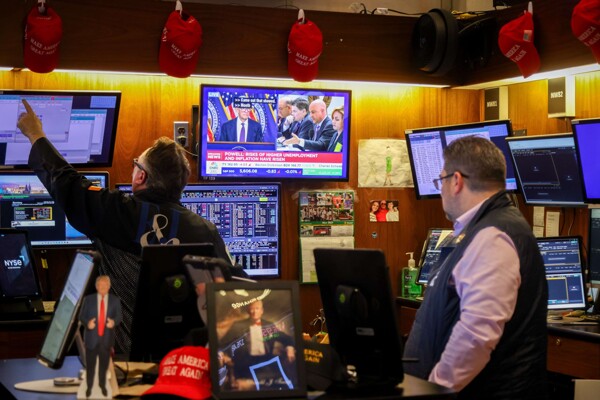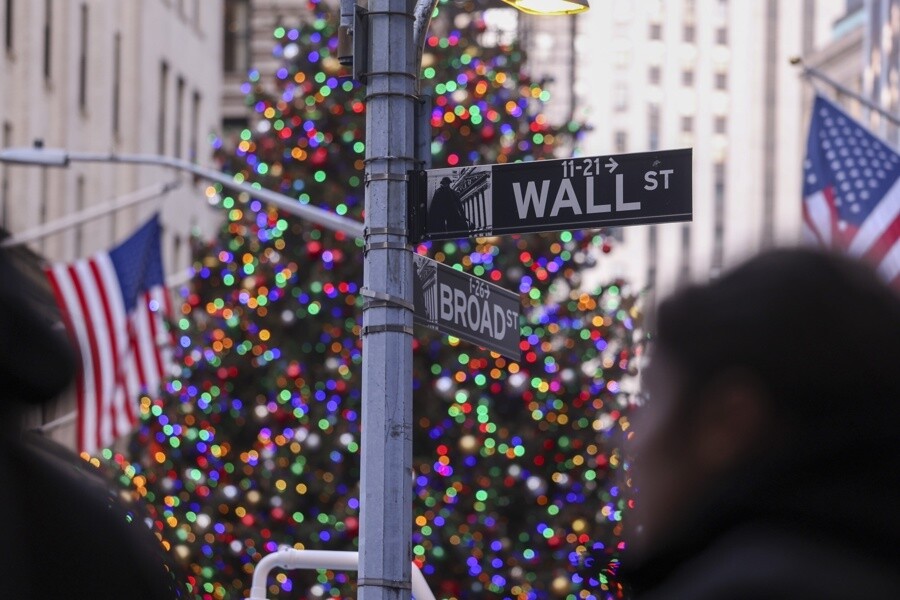
Wall Street wraps up 2025 with notable gains, a year marked by U.S. tariff policy, Federal Reserve interest rate cuts, and an artificial intelligence (AI) boom that has propelled the tech sector. After the final trading day, the Dow Jones Industrial Average closes with a cumulative annual gain of 12.97%, the S&P 500 with 16.39%, and the tech-heavy Nasdaq with 20.36%. At the open, indices fell around 0.25% after the release of weekly U.S. jobless claims data, which dropped to 199,000, better than expected. By the close, the Dow Jones fell 0.63% to 48,063 points; the S&P 500 lost 0.74% to 6,845; and the Nasdaq retreated 0.76% to 23,241. This marks the third consecutive year of double-digit gains, though more moderate than the previous one. Many analysts noted that in the first months, European stock markets outperformed the U.S. one, although the trend did not consolidate. Key factors included President Donald Trump's aggressive tariff policy announced on April 2, which the next day caused the worst stock market session since the 2020 COVID-19 crisis, leading to a volatile trade war. In fact, the best day of the year came a week later when Trump announced a truce for countries willing to negotiate these tariffs, and indices had a spectacular rebound, with gains exceeding the initial drop. On April 3, the Nasdaq fell nearly 6%, the S&P 500 nearly 5%, and the Dow 4%; while on April 9, the Nasdaq surged 12%, the S&P 500 9.5%, and the Dow Jones nearly 8%. Fed rate cuts and tech gains. The economic uncertainty generated by import tariffs, among other Trump administration measures, complicated the Federal Reserve's dual mandate, which led to three interest rate cuts in September, October, and December. In December, the Fed cut rates by a quarter-point to a range of 3.5% to 3.75%, a decision more contentious within the body than in 2019, according to meeting minutes published this week. In parallel, the tech sector, boosted by rate cuts, has been one of the market's main drivers thanks to high expectations for AI development, although experts warn of a possible bubble and high valuations. AI chip leader Nvidia closed the year as the world's most valuable company with a market cap of $4.56 trillion, followed by Apple ($4.05 trillion), Alphabet ($3.80 trillion), Microsoft ($3.62 trillion), and Amazon ($2.47 trillion). However, the gains of these firms—Alphabet up 66%, Nvidia up 35%, or Apple up 12%—pale in comparison to smaller tech firms like Sandisk (567%), Western Digital (289%), Micron (248%), or Seagate (224%), which are the 'best in class' of the S&P 500. Texas oil in decline. In other markets, Texas oil fell nearly 20% this year, weighed by expectations of a global supply glut, despite the bullish effect of geopolitical tensions in the Middle East and the Russia-Ukraine war. The 'debasement trade' investment strategy, which bets on alternative assets like gold and bitcoin amid expectations of a weakening dollar, has also gained traction, explaining some of their rises. Precious metals closed a record year, with gold 70% more expensive at around $4,549 per ounce, and silver 160% more expensive at around $84. Bitcoin, which hit a record of $125,000 in late September, ended the year at around $88,000.